Democratic accountability
Studying the consequences of the Covid19 pandemic in terms of democratic accountability represents a rich research agenda. Citizens’ responses to the unprecedented pandemic policies, and to the subsequent expected economic crisis, is crucial to understand the functioning of democracies and will most likely be multifaceted (electoral behavior, trust and evaluation of institutions and policies, blame attribution). For instance, initial findings on citizens’ response to the Covid-19 pandemic show a ‘rally around the flag effect’
27,
28. However, this effect should be qualified since it is neither universal
29 nor similarly lasting as the crisis endures
30, or rather producing a ‘
crisis signal effect that benefits incumbents’
31.
Research suggests that the pandemic has triggered stronger support or satisfaction with the governments and their policy – largely mediated by levels of trust and partisanship32. The CAUCP data confirms that citizens’ policy response is complex and context dependent. Looking at the satisfaction with the government’s handling of the Covid19 crisis,
we observe important time and country variation (Fig.
4). Indeed, in the different countries, the level of satisfaction is extremely high (Australia, New Zealand, Austria), average (France, Italy, USA), or generally low (Brazil, Poland). Additionally, trends of satisfaction are either increasing (Australia), stable (France, New Zealand), or declining (Sweden, United Kingdom). In addition to attitudes toward the government, social science research should further investigate the electoral consequences of the crisis. Indeed, local sanitary contexts and corresponding health policies have affected turnout rates in several European local elections, increasing turnout in some cases
33 or depressing it in others
34,
35. Further, the Covid19 pandemic has influenced voting behavior, generally to the benefit of incumbents and Green parties in local elections
36. How consistent are these patterns? Are they dependent on the context of the pandemic and the policy response? Do they hold for national and local elections? Such questions enable to investigate promising research venues on the effects of retrospective vote choice on attitudes, as well as on the consequences of the crisis on prospective vote choice, and actual electoral behavior as three countries held national elections in 2020 (USA, New Zealand, and Poland). Evaluating the significance of individual-level health and economic situations on political behavior and attitudes constitute a promising research lead, as most studies examined these questions at the aggregate level thus far.
Fig. 4
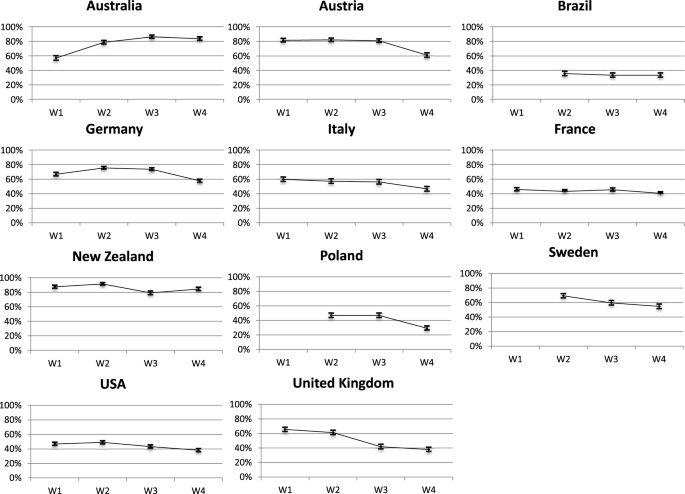
Satisfaction with the government’s handling of the Covid19 crisis. Question wording: “Generally speaking, are you satisfied with the way that the government is handling coronavirus?” – 4-point Likert Scale. shows the proportion of respondents that are “completely satisfied” or “quite satisfied”.

