Lithopedion
From Wikipedia, the free encyclopedia
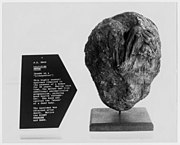
A lithopedion. This highly unusual specimen remained in the abdomen of a woman for 55 years. During this time the mother had five additional uncomplicated pregnancies.
A
lithopedion (Greek:litho =
stone; pedion = child), or
stone baby, is a rare phenomenon which occurs most commonly when a
fetus dies during an
abdominal pregnancy,
[1] is too large to be reabsorbed by the body, and calcifies on the outside, shielding the mother's body from the dead tissue of the baby and preventing
infection. Lithopedia may occur from 14 weeks gestation to full term. It is not unusual for a stone baby to remain undiagnosed for
decades, and it is often not until a
patient is examined for other conditions or a proper examination is conducted that includes an
X-ray, that a stone baby is found. The oldest reported case is that of a 94 year old woman,
[2] whose lithopedion has been present for upwards of 60 years.
The condition was first described in a treatise by the physician
Albucasis in the 10th century AD, but fewer than 300 cases have been noted in 400 years of medical literature. The earliest lithopedion is one found in an archaeological excavation, dated to
1100 BC.
A related condition is known as
vanishing twin, in which the fetus is one of two or more sharing the
uterus. If the fetus is older than eight weeks at the time of its
death, and is retained in the
uterus for at least ten weeks, it may undergo mechanical
compression such that it takes on a flattened, mummified appearance with a surface texture resembling that of
parchment.
[edit] In popular culture

