Afterlife viewpoints
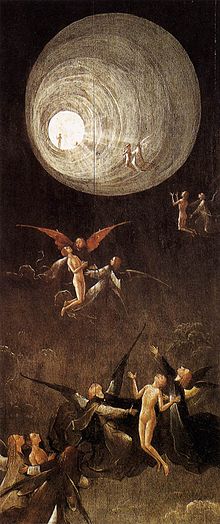
 Ascent of the Blessed
 by
Hieronymus Bosch
Many view the NDE as the precursor to an
afterlife experience, claiming that the NDE cannot be adequately explained by physiological or psychological causes, and that the phenomenon conclusively demonstrates that human consciousness can function independently of brain activity.
[70] Many NDE-accounts seem to include elements which, according to several theorists, can only be explained by an
out-of-body consciousness. For example, Michael Sabom states that one of his contacts accurately described a surgical instrument she had not seen previously, as well as a conversation that occurred while she was under general anesthesia.
[71] In another account, from a prospective
Dutch NDE study,
[15] a nurse removed the
dentures of an unconscious
heart attack victim, and was identified after his recovery as the one who removed them. This surprised him, as that patient had been in a deep coma and undergoing
cardio-pulmonary resuscitation at the time.
Dr. Michael Sabom reports
a case about a woman who underwent surgery for an
aneurysm. The woman reported an out-of-body experience that she claimed continued through a brief period of the absence of any
EEG activity.
[71]
Many individuals who experience an NDE see it as a verification of the existence of an afterlife.
[72] This includes those with agnostic/atheist inclinations before the experience. There are examples of ex-
atheists, such as the Reverend
Howard Storm,
[73] adopting a more spiritual viewpoint after their NDEs. Storm's NDE may also be characterized as a distressing near-death experience.
[74]
Likewise, individuals who do not experience an NDE after going into cardiac arrest frequently lose any preexisting belief in an afterlife
[15]. Both processes, like most of the psychological transformations associated with a close brush with death, take place gradually over several years.
[15]
Greyson claims that: "No one physiological or psychological model by itself explains all the common features of NDE. The paradoxical occurrence of heightened, lucid awareness and logical thought processes during a period of impaired cerebral perfusion raises particular perplexing questions for our current understanding of consciousness and its relation to brain function. A clear sensorium and complex perceptual processes during a period of apparent clinical death challenge the concept that consciousness is localized exclusively in the brain."
[75]
Another account by a student nurse named Jeanette Atkinson from Eastbourne, who experienced a near-death experience, says that, "There is no doubt in my mind that there’s life after death because I’ve seen the other side. I don’t believe in a benevolent God. I’ve seen too much suffering for that but I’m very spiritual." A recent study by Dr. Sam Parnia, shows that such patients are "effectively dead", with their brains shut down and no thoughts or feelings possible for the complex brain activity required for dreaming or hallucinating; additionally, to rule out the possibility that near-death experiences resulted from hallucinations after the brain had collapsed through lack of oxygen, Parnia rigorously monitored the concentrations of the vital gas in the patients’ blood, and found that none of those who underwent the experiences had low levels of oxygen. He was also able to rule out claims that unusual combinations of drugs were to blame because the resuscitation procedure was the same in every case, regardless of whether they had a near-death experience or not. According to Parnia, "Arch sceptics will always attack our work. I’m content with that. That’s how science progresses. What is clear is that something profound is happening. The mind – the thing that is ‘you’ – your ‘soul’ if you will - carries on after conventional science says it should have drifted into nothingness."
[76][77]

